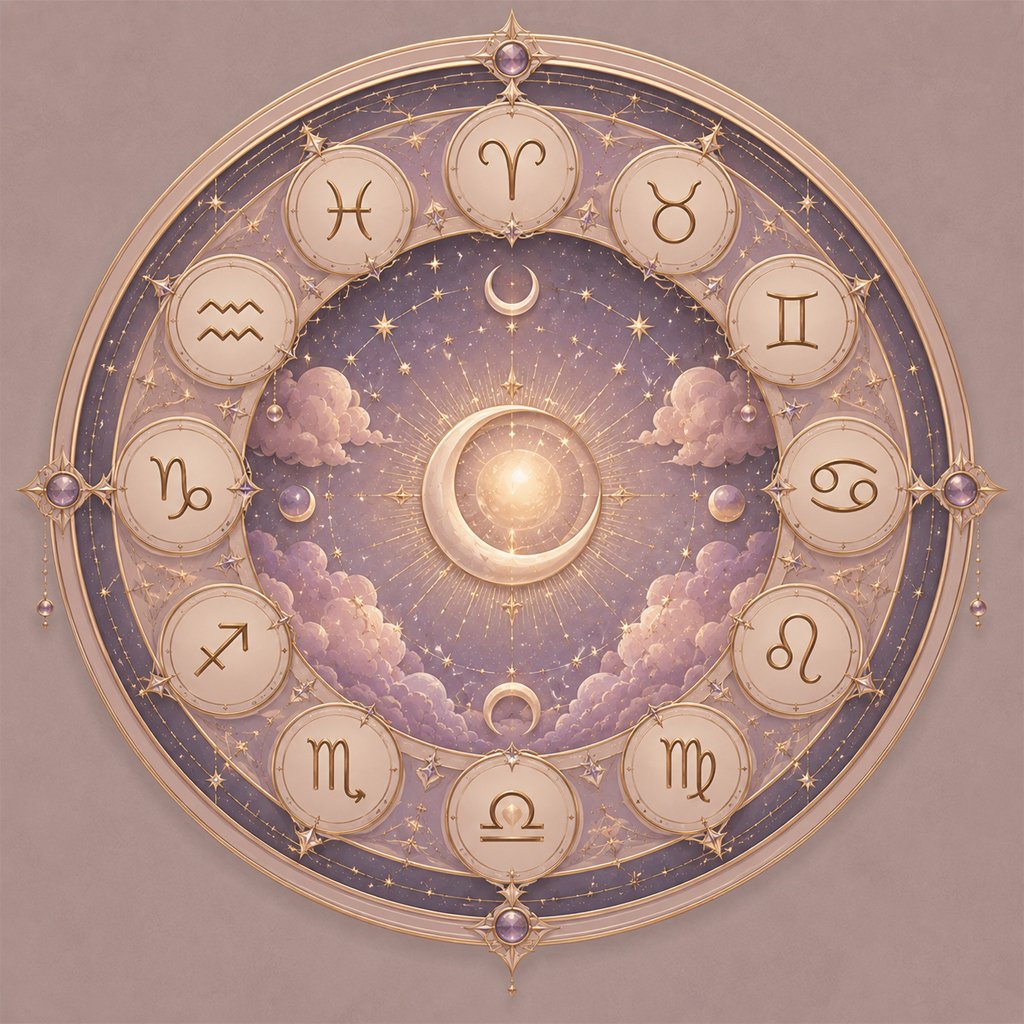
The Twelve Houses
The twelve areas of life a natal chart divides into.
What The Houses Add
Signs describe style and planets describe function, but neither says where in a life something happens. That is what the houses are for. The twelve of them divide the chart into areas of experience — self, resources, communication, home, creativity, work, partnership, and so on — and a planet's house placement says which part of a life its function is most visible in.
The difference this makes is concrete. Mars in Aries describes a direct, fast-moving drive whoever holds it. Mars in Aries in the tenth house points that drive at career and public standing; the same Mars in the fourth points it at home and family. The quality of the energy is identical and the life it produces is not.
Houses are also what make a chart genuinely individual. Sign positions repeat for everyone born in the same period, but the houses depend on the exact time and place of birth — the wheel rotates completely every twenty-four hours. Two people born the same day in the same city, four hours apart, share almost every planetary sign and share very little of the house structure.
The Angular Houses
Four houses sit at the cardinal points of the chart and carry more weight than the others. The first house begins at the ascendant and describes self-presentation: the manner a person leads with, and the impression formed before anyone knows them. The fourth describes home, family, and the private base a life is run from. The seventh, opposite the first, describes partnership — what someone looks for in a close other, and what they tend to project onto them. The tenth describes work, reputation, and public standing.
These four are called angular, and a planet placed in one of them is unusually prominent. If a chart has a single planet in an angular house and the rest scattered elsewhere, that planet often describes the thing people notice first.
The Remaining Eight
The second house covers resources and what a person values materially; the third, communication, siblings, and the immediate environment; the fifth, creativity, romance, and play; the sixth, daily work, routine, and the systems that keep an ordinary week functioning.
The eighth covers shared resources and the things that change a person permanently; the ninth, travel, education, and belief; the eleventh, friendship, community, and long-range hopes; the twelfth, solitude, the unconscious, and whatever operates below the level of deliberate attention. An empty house is entirely normal — there are twelve houses and ten planets, so at least two will always be empty, and it means nothing more than that the area is not a headline theme.
House Systems And Birth Times
There is more than one method for dividing the wheel into houses. Placidus is the most widely used in modern Western astrology; whole sign, the oldest, assigns one sign to each house and is increasingly common again; equal house splits the circle into twelve identical segments from the ascendant. They agree on the broad structure and disagree at the edges, so a planet near a house boundary may change houses depending on the system.
All of them depend on an accurate birth time. An error of a few minutes rarely matters; an error of a few hours moves every house cusp and changes the ascendant entirely. If your recorded time is uncertain, the sign positions in your chart are still reliable — it is only the house layer that becomes provisional.
The Four Angles
The boundaries of the angular houses have names of their own and are read as points in their own right. The ascendant, at the start of the first house, is the sign rising on the eastern horizon at the moment of birth. It describes the manner a person leads with — often closer to how they are described by others than how they would describe themselves.
Opposite it, the descendant marks the seventh house and describes what someone seeks in a partner. The midheaven, at the top of the chart, marks the tenth and describes public direction and the shape of a working life. Its opposite, the imum coeli, marks the fourth and describes private foundations. Together the four angles form the frame the rest of the chart is arranged inside.
Reading A House In Practice
Three things describe any house: the sign on its cusp, any planets inside it, and the position of the planet that rules that sign. The cusp sign gives the manner in which the area is approached. Planets inside show functions actively at work there. The ruling planet, wherever it sits, shows what the area is connected to elsewhere in the life.
A worked example makes the method clearer. Suppose the seventh house begins in Capricorn with no planets in it, and Saturn — which rules Capricorn — sits in the tenth. Partnership is approached seriously and slowly, there is no single dominant dynamic operating within it, and the whole area is tied to work and public standing. That is a specific reading, and it came from three pieces of information rather than a memorized keyword.
Reading houses this way keeps the chart connected to itself. Each area points somewhere else, and following those pointers is what turns a list of placements into an account of one life rather than twelve unrelated summaries.