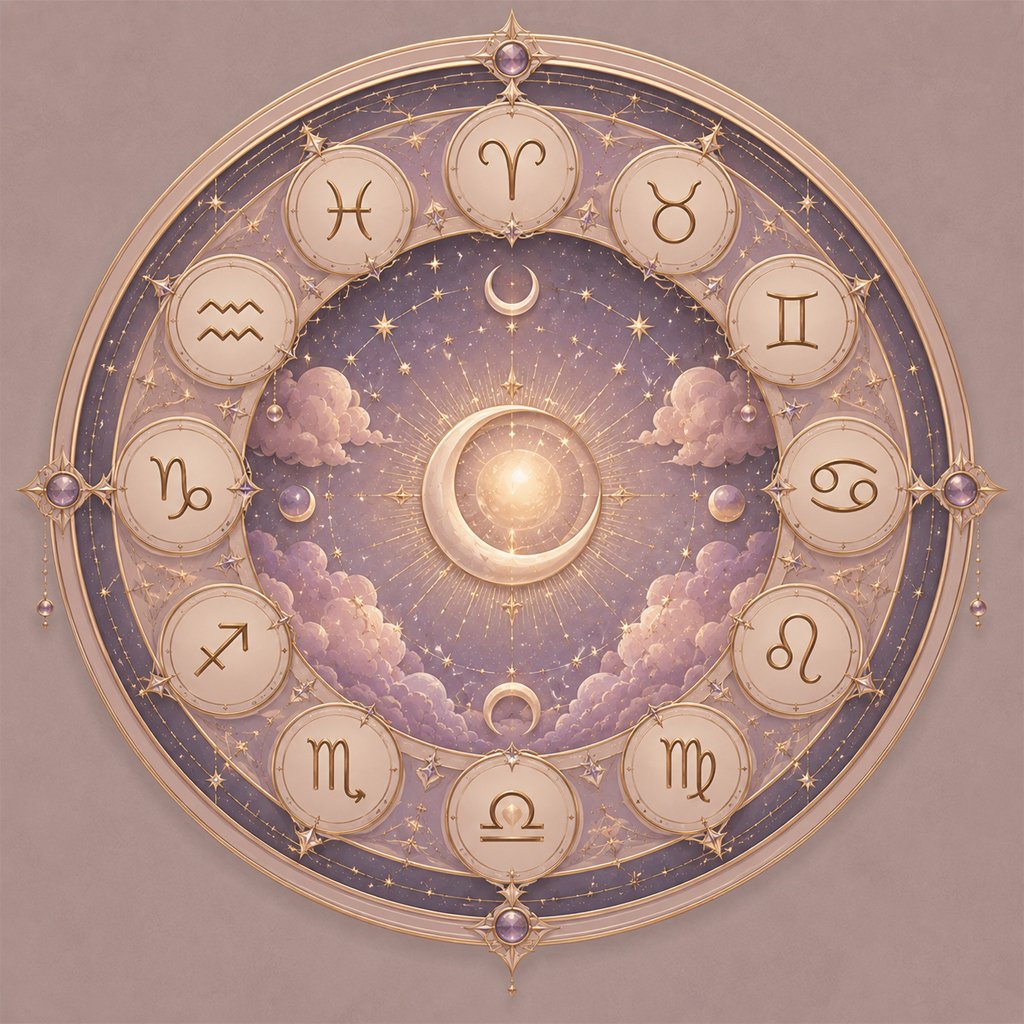
Ninth House Belief and Travel
The ninth house is the search for meaning: philosophy, religion, higher education, foreign places. Where the third house learns facts, the ninth looks for what they add up to.
- Governs
- Philosophy, higher study, long journeys
Connected Sign
The Twelve Houses
What The Ninth House Covers
The ninth house describes belief, higher study, and long journeys — the things that change how somebody understands the world rather than adding to what they already know. It is the house of the wider frame.
It is cadent, sharing the character of the mutable signs, with Sagittarius as its natural sign and Jupiter as ruler. That supplies its vocabulary: expansion, meaning, and the search for a larger context.
It sits opposite the third, and the pair divides knowledge into the near and the far. The third covers daily information; the ninth covers what somebody does with it once they start asking what it all amounts to.
Belief And Meaning
This house covers religion, philosophy, politics, and any framework somebody uses to make sense of things — including the decision that no such framework is available. What matters is the relationship to the question rather than the answer arrived at.
The sign on the cusp describes the manner. A fire sign here suggests conviction held enthusiastically; an earth sign a preference for beliefs that produce something practical; an air sign a taste for examining a position from several sides; a water sign belief grounded in experience rather than argument.
Planets in the house describe what is active. Jupiter here is at home and describes somebody genuinely drawn to the large questions; Saturn suggests belief arrived at slowly and defended carefully; Uranus suggests a framework that departs from whatever was inherited.
Travel And Higher Study
The traditional distinction between third and ninth house travel is about effect rather than distance. A commute belongs to the third; a journey that changes how somebody sees things belongs here, whatever its length.
The same logic applies to education. Learning a fact belongs to the third; studying something long enough that it reorganizes your assumptions belongs to the ninth. Formal higher education usually falls here, though the tradition is describing the depth rather than the institution.
Foreign countries and people from elsewhere are traditionally assigned to this house on the same reasoning — contact with a different frame of reference, which is the recurring theme throughout.
Reading The House In Practice
Three things describe any house: the sign on its cusp, the planets in it, and where the ruler of that sign sits. For the ninth this produces an account of how somebody arrives at what they believe.
A worked example: the ninth house beginning in Virgo, empty, with Mercury in the sixth. Belief is approached analytically and tested against detail, nothing dominates the area directly, and the whole subject ties to daily work — someone whose philosophy is worked out through practice rather than through reading.
The reading is specific enough to disagree with, which is the standard any interpretation should meet.
Common Questions
Does the ninth house predict travel? No. Nothing in a chart predicts anything. It describes a disposition toward the unfamiliar and toward questions of meaning, not a set of future journeys.
What is the difference between the third and ninth houses? The third covers near learning — daily information, conversation, short trips. The ninth covers what changes a frame of reference: belief, deep study, and journeys that leave somebody different.
What if the house is empty? Read the sign on its cusp and follow its ruler. An empty ninth house does not indicate an absence of belief, only that the area is not a headline theme.
Which planet rules it? Jupiter, in both the classical and modern schemes. It is one of the houses where the two conventions agree completely, which is not true of the eighth, eleventh, or twelfth.
Publishing And Teaching
Traditional sources add publishing, teaching, and law to this house, and the grouping makes sense once the underlying theme is clear. Each involves taking a framework and transmitting it — moving understanding outward rather than acquiring it.
Law belongs here in the sense of legal principle and the system of it, as distinct from an individual dispute, which the seventh house covers. The distinction is between the framework and the case.
For modern readers the useful version is broader: this house covers whatever somebody does with a body of understanding once they have one. Teaching, writing, and arguing a position all sit here.
What It Does Not Do
Nothing in this house indicates what somebody should believe, and no placement makes any framework more or less correct. It describes a relationship to the question of meaning, not an answer to it.
It also does not predict travel, education, or anything else. A chart describes disposition, and reading a house as a forecast of events is the most common way this material gets misused.
Nothing on this page is advice about study, work, religion, or any decision with consequences attached to it. Where a reading of this house resonates, the useful response is to examine the actual question it seems to touch on rather than to treat the placement itself as any kind of answer to it.