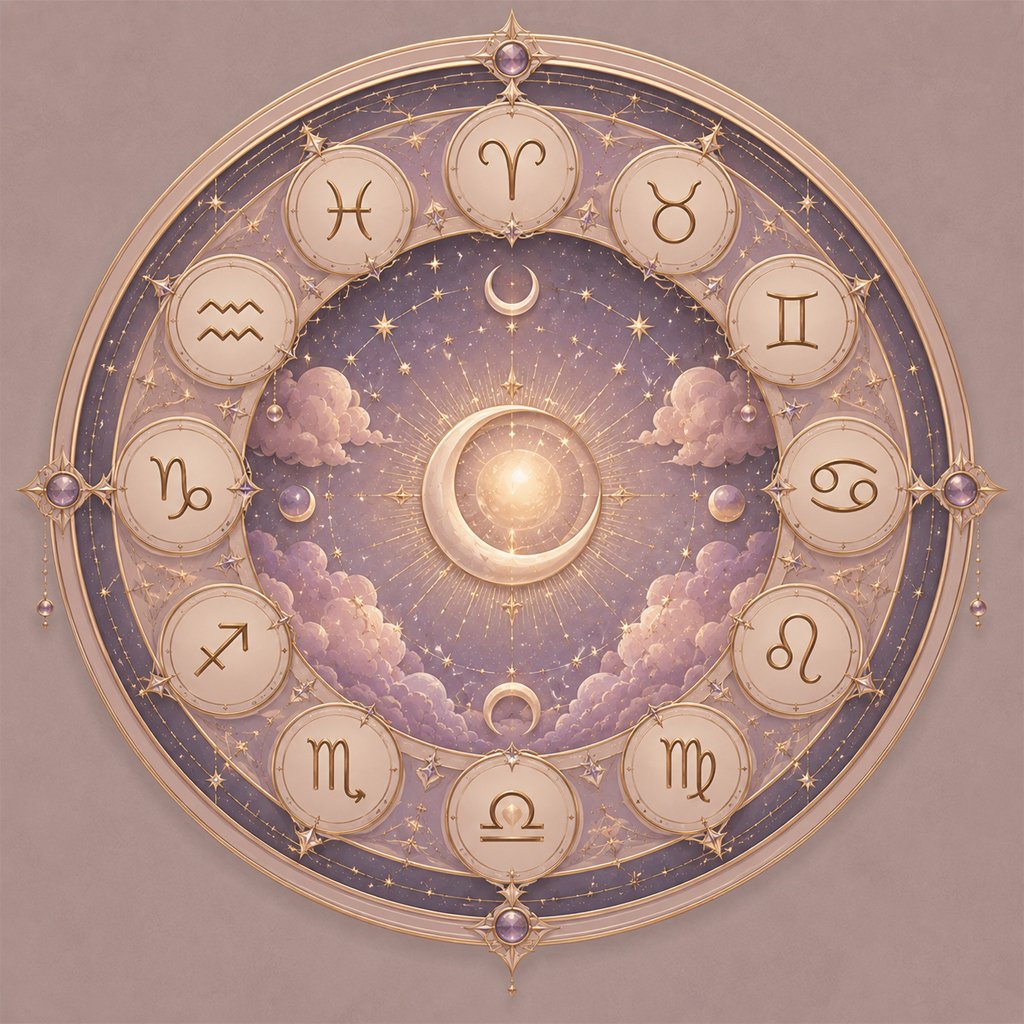
Eleventh House Friendship and Hopes
The eleventh house covers the wider circle: friends, groups, causes and the future you are working toward. It is where you belong to something larger than yourself.
- Governs
- Community, networks, long-term goals
Connected Sign
The Twelve Houses
What The Eleventh House Covers
The eleventh house describes friendship, community, and long-range hopes — the groups somebody belongs to, and what they are working toward beyond their own immediate circumstances.
It is succedent, sharing the character of the fixed signs, with Aquarius as its natural sign. Its ruler is Saturn in the classical scheme and Uranus in the modern one, and the two conventions produce noticeably different readings.
It sits opposite the fifth, and the pair divides social life into the personal and the collective — individual expression against belonging to something larger.
Friendship And Groups
This is the house to look at for friendship specifically, rather than the seventh, which covers one-to-one partnership. The eleventh describes how somebody functions as part of a group and what they want from belonging to one.
The sign on the cusp describes the manner. A fire sign suggests friendships formed quickly and warmly; an earth sign few and durable ones; an air sign a wide network held together by conversation; a water sign a small circle where the connection runs deep.
Planets in the house describe what is active. Saturn here suggests somebody who takes their obligations to a group seriously and may feel slightly outside it; Jupiter suggests an expansive social life; Uranus suggests belonging to groups that do not quite fit anywhere.
Hopes And Long-Range Goals
The second meaning of this house concerns what somebody is working toward over a horizon longer than a career — the outcome they would like to see, whether or not they expect to be there for it.
The traditional grouping of this with community is deliberate. Long-range hopes are usually collective rather than personal, and the things people most want to see happen tend to involve more than themselves.
Read as a question, this house asks what somebody is contributing to that outlasts them. That is a large question and a genuinely useful one, and it is the part of the house most often skipped in favor of a list about friendship.
Reading The House In Practice
Three things describe any house: the sign on its cusp, the planets in it, and where the ruler of that sign sits. For the eleventh this produces an account of how somebody belongs to things.
A worked example: the eleventh house beginning in Cancer, empty, with the moon in the fourth. Community is approached protectively and privately, nothing dominates the area directly, and the whole subject ties back to home — somebody whose friends function as an extended family rather than as a network.
Three pieces of information, one specific reading. That is the method, and it works the same way in every house.
Common Questions
What is the difference between the seventh and eleventh houses? The seventh covers one-to-one relationships including marriage and business partnership; the eleventh covers groups, friendship, and community. A close friendship can sit in either depending on whether it functions as a partnership or as part of a wider circle.
Which planet rules it? Saturn in the classical scheme, Uranus in the modern one. Traditional astrologers use Saturn and read the house rather differently as a result.
What if the house is empty? Read the sign on its cusp and follow its ruler. An empty eleventh house does not indicate a lack of friends, only that the area is not a dominant theme.
The Two Rulership Schemes
This house shows the difference between classical and modern attribution more clearly than most. Read through Saturn it describes structure, obligation, and the seriousness of belonging to something — a considerably more sober account than the modern one.
Read through Uranus it describes independence, unconventional groups, and a certain distance from whatever the mainstream is doing. Both readings are recognizable, and which one applies to a given chart is not something the system settles.
The practical approach is to read both and see which fits. Where they disagree the disagreement is usually informative, and treating either as the correct one closes off something worth noticing.
What It Does Not Do
Nothing in this house predicts friendship, community, or how anybody's hopes turn out. It describes a disposition toward belonging, which is a statement about temperament and not about circumstances.
It also says nothing about other people. A chart describes its subject, so a difficult eleventh house is not a statement about anybody's friends and should never be read as one.
The most common misuse of this house is treating it as a guide to which people to keep close, which asks the system for something it has no way of supplying. Friendship is assessed on the ordinary evidence of how somebody behaves over time.
Read as a description of how you belong to things, rather than of who belongs to you, the house becomes considerably more useful and considerably harder to misapply. The first version is a question about yourself, which a chart can reasonably prompt; the second is a judgment about other people, which no chart is equipped to make on anybody's behalf.