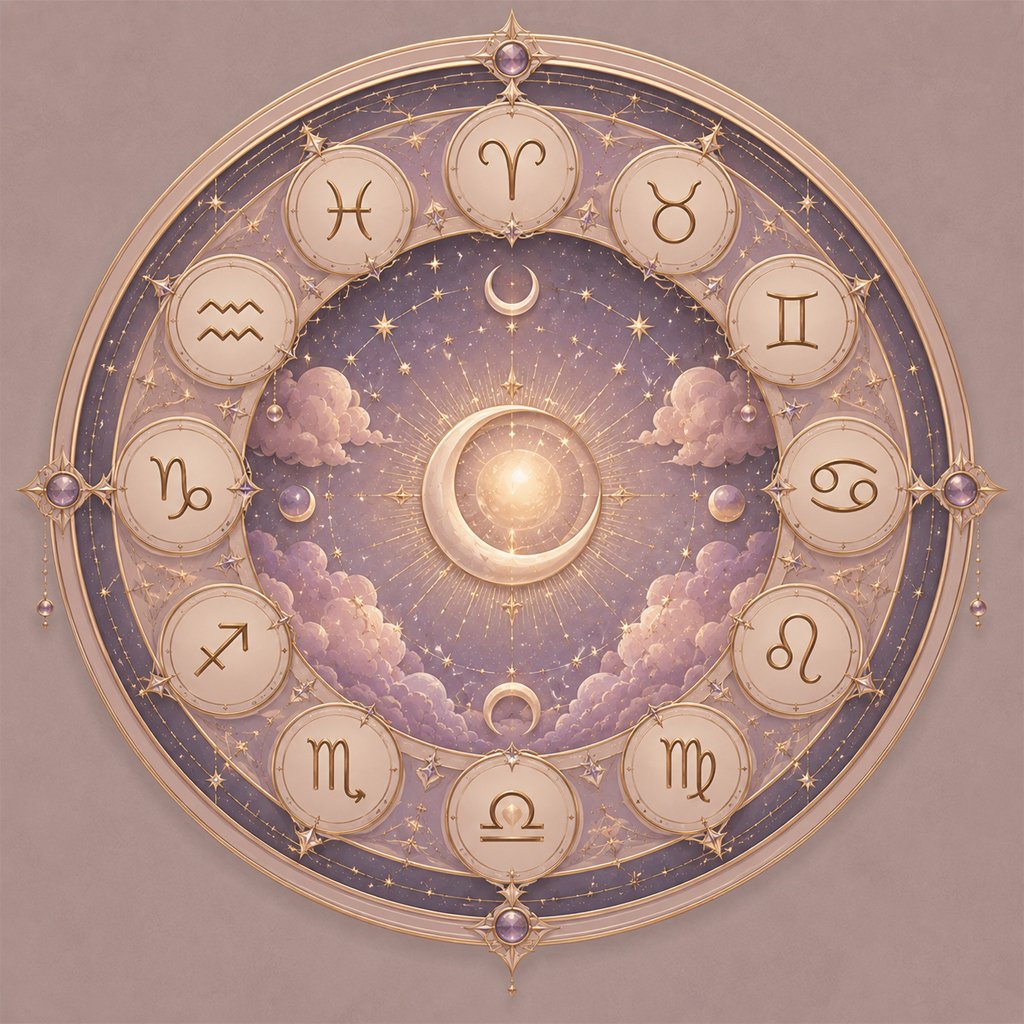
What the 12 Houses Mean in Astrology
Of the three layers in a natal chart — planets, signs and houses — the houses are the one most often skipped, and the one that makes everything else make sense. Planets say what is happening. Signs say how. Houses say where in your life, and without that, a chart reading stays abstract.
Two people can both have Venus in Taurus. In one chart it sits in the second house and describes a person with expensive taste and a talent for making money. In the other it sits in the ninth and describes someone who falls in love with places, languages and ideas from somewhere else. Same planet, same sign, different life.
You can see your own house placements on your natal chart.
Where the houses come from
The signs divide the sky by the Earth’s yearly orbit. The houses divide it by the Earth’s daily rotation — which is why they need your birth time and the houses of someone born six hours later are completely different.
The first house begins at the ascendant, the point rising on the eastern horizon at your birth. From there the wheel runs anticlockwise through twelve segments. Because the Earth turns once a day, the entire house structure cycles every twenty-four hours.
Several systems exist for dividing the wheel. Placidus is the most widely used in Western astrology and divides by time rather than by equal angle, which is why house sizes vary. Whole-sign houses, older and simpler, give each house exactly one sign. Our calculator uses Placidus, falling back to equal houses above the polar circles where Placidus is mathematically undefined.
The angular houses: 1, 4, 7, 10
Four houses begin at the chart’s most sensitive points, and planets in them tend to be the loudest in a chart.
The first house begins at the ascendant and governs the self as presented: appearance, manner, the immediate impression. Planets here are visible — people notice them on you before they know you. Mars in the first reads as direct and physically forward. Neptune in the first is harder for people to pin down.
The fourth house begins at the lowest point of the chart and governs home, family, roots and the private base you retreat to. It describes both the family you came from and the one you build. Planets here often operate out of sight of everyone but your household.
The seventh house begins at the descendant, opposite the ascendant, and governs one-to-one partnership: marriage, business partners, close alliances and open enemies. It describes the qualities you look for in others and, traditionally, the qualities you find hardest to own yourself.
The tenth house begins at the midheaven, the highest point, and governs career, public standing and reputation. Not simply your job — the thing you are known for. Planets here are the most publicly visible in the whole chart.
The remaining eight
The second house governs resources: money you earn, possessions you own, and your sense of your own worth. The financial and the psychological are deliberately combined here — traditional astrology treats self-worth and net worth as the same subject.
The third house governs communication, everyday thinking, siblings, short journeys and early education. This is the house of the immediate environment: the people you talk to daily and the way your mind handles ordinary information.
The fifth house governs creativity, romance, play and children. Anything you make and put your name on, including offspring. Where the seventh house is about partnership as commitment, the fifth is about romance as pleasure.
The sixth house governs work as distinct from career, daily routine, health and service. The tenth house is what you are known for; the sixth is what you actually do on a Tuesday. It also covers the body’s maintenance — diet, exercise, the habits that keep the machine running.
The eighth house governs shared resources, inheritance, debt, intimacy and transformation. It is where the second house’s “mine” becomes “ours”. Traditionally the house of death, which in modern practice reads more frequently as the endings that reorganise a life.
The ninth house governs long-distance travel, higher education, philosophy, law and belief. Where the third house handles information, the ninth handles meaning — the search for a framework that explains things.
The eleventh house governs friendship, groups, networks and long-range hopes. The community you choose, as opposed to the family you were given in the fourth.
The twelfth house governs what is hidden: the unconscious, solitude, institutions, and the parts of yourself you cannot easily see. Planets here often operate powerfully but invisibly, and are frequently the last placements a person recognises in themselves.
Reading houses in your own chart
Three questions get you most of the way.
Which houses hold planets? These are the areas of life that get the most energy. A chart with four planets in the tenth house belongs to someone whose public work will not be a side concern.
Which houses are empty? Eight or nine houses in most charts contain nothing, and this is normal — ten planets cannot fill twelve houses. An empty house is not a void in your life. It means that area runs on the ruler of its cusp sign rather than on a planet sitting inside it.
Where are the Sun, Moon and ascendant ruler? These three tend to describe the spine of a life. The Sun’s house is where you most need to shine; the Moon’s house is where you go for comfort.
Houses and signs are not the same thing
This is the most persistent beginner’s confusion, partly because the two systems are often taught with the same imagery. The first house is associated with Aries, the second with Taurus, and so on — a correspondence that makes the houses easier to memorise and easier to misunderstand.
The association is thematic, not literal. Having planets in the first house does not make you Aries-like. If your rising sign is Capricorn, your first house is in Capricorn and behaves accordingly.
Keep the layers distinct: the sign is how, the house is where. Mars in Gemini in the sixth house pursues things through words and quick thinking (Gemini), and does it in the arena of daily work and routine (sixth house).
Where to go next
Look at your own chart and find the three or four houses that actually contain planets — that is where your chart is concentrated. Calculate it here if you have not yet.
From there, our guide to the ten planets explains what each one brings to whichever house it lands in, and the astrology fundamentals guide covers how the signs modify it.